
Many of you may ask questions like: why is cenote diving interesting? What is fun about it if there is no marine life? You may even hear statements like “It must be just looking at rocks” or “All cenotes must be the same”. Those are exactly the questions we will address and clarify in this post.
It is important to note that diving in a cenote, or more specifically in the cavern zone of a cenote for recreational divers, can be extremely different depending on the location and the type of cenote. In Mexico, the Yucatán Peninsula offers a variety of cenotes that we can broadly divide into two main types: cenotes that are usually very deep with a geography similar to a vertical cylinder, and cenotes that feel like submerged labyrinths because they have underwater caves and are relatively shallow compared to cylindrical cenotes. The differences and formation processes are topics we will explain in another article.
With that in mind, the dive you choose will depend greatly on what you want to experience. You might be looking for rocky formations in a “labyrinth” like the dives at Dos Ojos Park, or for majestic volumes of water and rock like Cenote Angelita with its hydrogen sulfide cloud, or even bright copper colored water caused by tannic acid, such as at Casa Cenote.
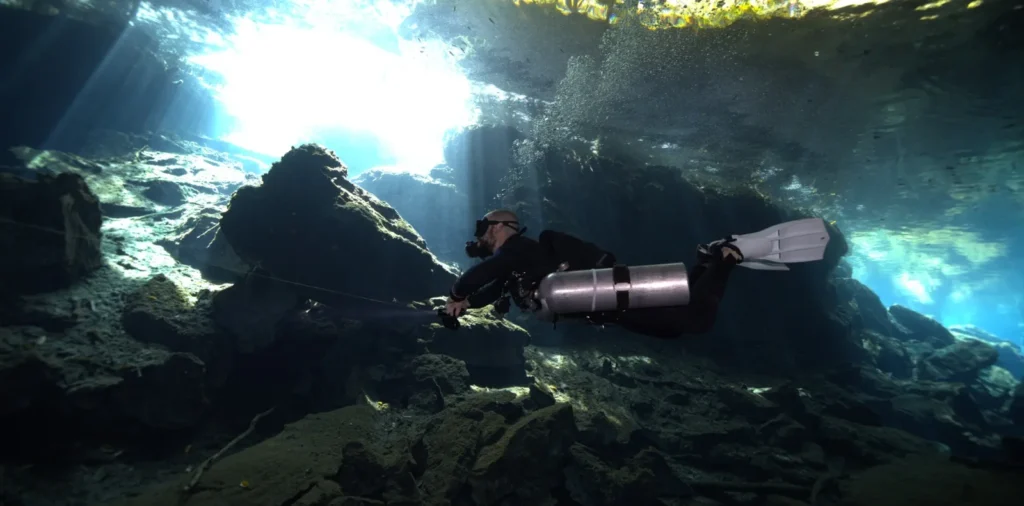
If you decide to dive in a cenote, you should be clear that the experience is more like entering a new world than doing an ocean dive, because the conditions and what you will observe are completely different. In the sea, you can feel currents, see sharks or marine life, admire reefs, explore shipwrecks, or simply connect with the “big blue”. In cenote diving, I will paint you a picture of a dive in Cenote Angelita: we bring our gear to the diving platform, go down the stairs, suit up, and begin a descent that seems endless toward the hydrogen sulfide cloud while the light keeps sending sunbeams down to where we are headed. We reach the cloud and start to cross it. In that moment, all we see are white waves that look like small storm clouds. If you lose focus, you can easily forget that you are in a cenote at around 30 meters depth and instead feel as if you are in the middle of a meditation or flying through clouds in an airplane. Your senses can become confused, and that is part of the magic. The cloud ends, we have crossed it, and now we are in what looks like an endless area of forest and peat. There is no sunlight anymore, and the cloud above us feels like the sky in complete darkness. We swim through the peat zone and see that this cenote once had trees. The roots rise from the depths like arms trying to escape, reaching for a bit of sunlight, but it is impossible: the cloud removes all possibility. The textures are dark and porous, yet with a refinement that only time and water can create in such massive rock formations. After a few minutes, it is time to ascend, cross the cloud again, let ourselves be hypnotized once more by the white waves, see the sun rays again, and experience the cavern that this cylindrical cenote offers. Unlike more cavernous cenotes, Angelita has a single passable cavern without the need for a guideline, because it is very short and has no forks that require navigation. We cross the cavern, we are closer to the surface, it is time to reach safety stop depth, and then finish the dive. Did you experience with me everything we lived in this cenote? In upcoming articles, we will explore different cenotes and the experiences you can have in them, as well as topics that go beyond diving, such as Mayan mythology, stories and experiences from cenote exploration, and a relationship that is rarely seen in diving: cenotes as places of biological and spiritual connection.

0 Comments